Taconic Regional OFC-Regional Parks Office, Staatsburg, New York
Thursday October 23, 2024; 8 am to 5:30 pm
State of Aquatic Habitat Restoration on the Hudson River Estuary
It had been thirty years since the State of New York and the Army Corps of Engineers identified the needs for an estuary-wide restoration plan to restore some of the habitats lost due to the extensive dredging and filling that occurred in the 20th century. Since then, many state, federal, and NGO staff have worked collaboratively to develop plans to establish restoration goals and identify priority restoration needs.
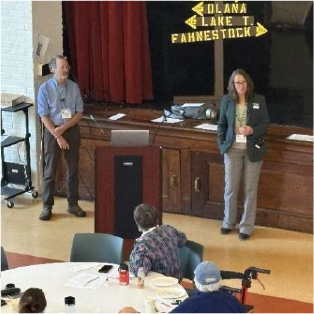
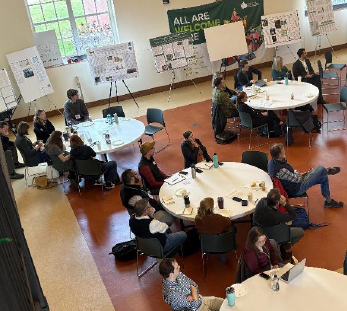
On October 23rd, 2025 the Hudson River Environmental Society held the 2025 Hudson River Symposium, the State of Aquatic Habitat Restoration on the Hudson River Estuary, at the Taconic Regional New York State Parks Office in Staatsburg, New York. The day’s activities included expert presentations of several habitat restoration projects followed by breakout sessions where participants shared their thoughts on how restoration could address the challenges of climate change, sea level rise, and changing biodiversity.
Download the presentation. (PDF)
Rob Pirani and Heather Gierloff opened the symposium with an overview of how the New York, New Jersey Harbor Estuary Program and the New York State Department of Environmental Conservation are working collaboratively to assure that planning efforts consider the restoration needs of the entire estuary. Much of the estuary has been impacted by dredging, filling, the release of industrial contaminants, and watershed scale changes in hydrology. The challenges to restore any portion of the estuary are immense so it is critical that the state and federal governments work as a team to identify priorities and seek and direct funding.
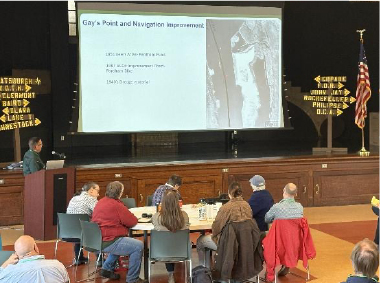
Dan Miller of NEIWPCC and the NYSDEC Hudson River Estuary Program provided an update on the back-channel restoration at Gays Point on the east side of the estuary in Columbia County. Funded as a mitigation project for the Tappan Zee Bridge replacement project, this was a first attempt to restore a tidal channel. The takeaway message from Dan was that costs and project design trade-offs are unavoidable and it is necessary to recognize that changing estuary conditions will define restoration achieved.
Sarah Fernald, Hudson River National Estuarine Research Reserve & NYSDEC, and Ashley Morris, NYSDEC provided an update on efforts to restore water celery beds (Vallisneria americana) in the freshwater tidal portion of the estuary. Success is proving challenging, and more research is needed to determine the environmental conditions and planting methods best suited to assure success. Future plans include targeting areas that had supported SAV beds in the past with the hopes of improving success.
Download the presentation (PDF).
Mike McCann from the Billion Oyster Project provided an overview to the historical extent of oysters in the estuary and the efforts being undertaken by the Billion Oyster Project to bring back a self-sustaining population. Oysters have been restored to many acres of the estuary but mortality is still outpacing recruitment. The issue is likely scale and what is needed are larger, interconnected sites to create a meta-population to allow for greater recruitment success. The program is investing in larger production facilities and will invest more in comprehensive site selection, larval modeling, and conduct more surveys.
Edwin McGowan from New York State Parks discussed the extensive control of common reed (Phragmites australis) in the Iona Marsh. In recent years common reed had dominated the tidal marsh and was likely responsible for the dramatic loss of nesting marsh birds between 1987 and 2004. With much of the common reed now eliminated, early results show a resurgence of marsh breeding birds but a more thorough study is needed. Lessons learned from this project include: 1. Early intervention is best for managing the spread of common reed; 2. Restored habitat can result in natural recolonization by mobile, marsh dependent species; 3. Planting is not necessary if seed source/bank is present; and 4. Long-term success requires vigilance and adaptive management.
Download the presentation. (PDF)
Download the presentation. (PDF)
Scott Cuppett, Cornell Water Resources Institute and NYSDEC Hudson River Estuary Program, discussed his work on directing dam removal projects to restore aquatic connectivity with the estuary. Though there is sufficient funding and the benefits to the ecosystem are well documented, it is challenging to have old, derelict dams taken down. There is resistance from dam owners and the regulatory process can be challenging. There needs to be a directed outreach campaign to both dam owners and communities along waterways with derelict dams pointing out the tremendous benefits of removing old dams. Often, the owners and the community are focused on the unlikely negative effects of removing dams and not the ecological, resilient, and aesthetic benefits.
Rebecca Swadek, New York City Department of Parks and Recreation gave a presentation on her work managing shoreline and shallow water restoration in the New York Harbor. The shoreline at several New York City parks have been eroding with loss of intertidal habitats. About a dozen sites are either in design, construction, or have been completed to date. Presenting one project as a case study, erosion of the site proved most challenging but the installation of coir logs did provide the protection necessary from plants to establish. Biodiversity increased quickly after restoration.
Download the presentation. (PDF)
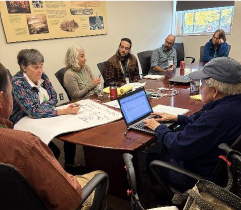
After the presentations were completed, participants split up into the following six restoration topic workgroups: Back Channels and Shallows, Submerged Aquatic Vegetation, Oyster Reefs, Biodiversity, Dams and Barriers, and Shorelines and Harbor Shallows. Each breakout group considered how restoration can address the challenges of climate change, sea level rise, and changing biodiversity focusing on the following three questions:
- What are the expectations & opportunities for restoration over the next decade;
- What technical, outreach, and scientific methods could be used to address these challenges; and
- How can we align science, policy, outreach, and regulation to ensure success?
The following table identifies six shared needs where more effort or resources were identified as necessary for the long-term success of habitat restoration.
| Restoration Type | Education & Outreach | Funding | Public Engagement | Mitigation Banking | Simplify Regulatory Process | Advance Scientific Knowledge |
|---|---|---|---|---|---|---|
| Back Channels & Shallows | X | X | X | X | X | X |
| Submerged Aquatic Vegetation | X | X | X | X | X | |
| Oyster Reefs | X | X | X | |||
| Biodiversity | X | X | ||||
| Dam Removal | X | X | X | |||
| Shoreline & Harbor Shallows | X | X | X | X | \ |
All six breakout groups identified the need to better educate the public on the need and benefits of restoration. For dam removals, a better, targeted education program is needed for dam owner acceptance and for those living along the impounded stream. Public engagement in the form of citizen science was also identified as a way to better convince the public that habitat restoration is important and necessary.
Thank you to all who helped us develop and deliver the program for the day! We are especially grateful for the support from the Hudson River Foundation, New York State Parks, New York-New Jersey Harbor Estuary Program and New York State DEC.